It is theorized that in chess, it is possible for the player with the first move (white) to always win or at least draw (Dimand and Dimand). While no computer has yet proved this conjecture, this is the tendency in Grandmaster play. The player with the initiative (tempo) can often use this initiative to gain positional or material advantage eventually leading to a situation where no matter what the opponent does, his next move will lead invariably to his doom (zugzwang). The very fact that he must move becomes his greatest liability. Thus it is often with politics.
In the latest Senate agreement, the majority party triumphs through forcing the opponent into a position where he must filibuster or confirm the fact that a nominee’s background, temperament, or politics is not “extraordinary” (out of the mainstream of what is acceptable). In a move of political jujitsu, three strong, pro-life nominees will be confirmed as mainstream by the minority party in the Senate, to wit, Judges Pryor, Rogers, and Owens. It is now more difficult to make a prima fascia case to the public that religious conservative jurists are “extreme” or “extraordinary”.
These justices then become a standard by which later nominees might be judged to warrant the “extraordinary” measure of the judicial filibuster. Every new confirmed nominee from henceforth only raises the bar on what is an extraordinary circumstance as opposed to what is merely politically adverse. The strength of the majority party game is in its ability to pick the order of nominees for presentation for confirmation. The majority now can use its tempo to greater advantage in a game that is quickly becoming more and more determinant.
On the other hand, the minority party is forced to react to the nominations by the limited commitment of whether or not to filibuster. Should they filibuster, others will have the opportunity to judge for themselves if an extraordinary case truly exists. This was and is always the political reality of the situation: the voters are deciding who is extreme and/or ineffectual. Should the filibuster be attempted (a cloture vote rejected), a good case will need to be made that the situation is truly extraordinary. If not, the “nuclear option” can be implemented under the same aforementioned agreement.
Unlike exercise for the muscles, this prerogative to filibuster weakens the case for a future filibuster with repeated use—it no longer appears to be conducted as an “extraordinary” measure and so the nuclear option gains strength. The minority party must bear the risk of losing their weapon and is forced to err on the safe side, i.e. to allow the majority party to repeatedly raise the bar on their future use of this political tool. Effectively, the minority party is in a situation now where their disadvantage in tempo has gained a position whereby zugzwang may be achieved.
The dark queen of the abortion lobby can no longer hold sway over her king. For the viability of the Democratic Party, the queen herself must now face the test. There are no more minor pieces left to sacrifice.
Monday, May 23, 2005


Thursday, March 31, 2005
Occam's Razor: Terri Schiavo
The most baffling thing to me about the Terri Schiavo situation is how difficult people make it to be in the face of such simplicity.
1. The government is executing a citizen that has not been accused of a capital offense.
2. This is not permitted by the US Constitution
Alright, I have corresponded with many people about this. The responses tend to fall along the lines:
i. She is not a person
ii. She is not being executed
iii. Florida law says she can be executed
iv. You are a right wing theocrat
v. It all depends on the meaning of the word 'is'.
Frankly, no response above is both true and sufficient to refute the simple two point argument. If you are able to do this, I would be greatly obliged.
UPDATE: The closest consideration of this fundamental issue that I have read to date comes from Alec Rawls at Error Theory and a discussion of the Supreme Court's role in breaching individual sovereignty by Matthew Franck.
UPDATE: This summary by William Anderson is also well worth reading. My sole disagreement is over the rectitude of withholding fluids from those in an "irreversible deep coma". Anderson is a neurologist, so I understand that there may be some meaning to the phrase that escapes me. However, I would draw the line only at "brain death" as the irreversibility and true nature of a "deep" coma is not knowable at this time.
1. The government is executing a citizen that has not been accused of a capital offense.
2. This is not permitted by the US Constitution
Alright, I have corresponded with many people about this. The responses tend to fall along the lines:
i. She is not a person
ii. She is not being executed
iii. Florida law says she can be executed
iv. You are a right wing theocrat
v. It all depends on the meaning of the word 'is'.
Frankly, no response above is both true and sufficient to refute the simple two point argument. If you are able to do this, I would be greatly obliged.
UPDATE: The closest consideration of this fundamental issue that I have read to date comes from Alec Rawls at Error Theory and a discussion of the Supreme Court's role in breaching individual sovereignty by Matthew Franck.
UPDATE: This summary by William Anderson is also well worth reading. My sole disagreement is over the rectitude of withholding fluids from those in an "irreversible deep coma". Anderson is a neurologist, so I understand that there may be some meaning to the phrase that escapes me. However, I would draw the line only at "brain death" as the irreversibility and true nature of a "deep" coma is not knowable at this time.
Monday, February 21, 2005
Deductions from Minimal Information: Terri Schiavo
I have deduced the following in respect to the Terri Schiavo affair:
1. It is unlikely that the husband is responsible for the initial injury.
(Why would he call Terri's father to assist while she was still alive?)
2. The Schindlers and Schiavo are mutually antagonistic.
(More or less a simple observation)
3. Terri is now being used as a pawn by both the pro-life and the euthanasia movements.
4. It is impossible to know what are Terri's wishes here. It is irresponsible to assume that she would wish to starve to death.
5. The Florida Courts are hopelessly dysfunctional. In particular, Judge Greer is acting outside the law.
6. Under present conditions, it is unlikely that Gov. Bush will provoke a Constitutional crisis.
7. It is possible that Terri's condition may improve in the future. In the next ten years, we may have the means to radically improve her condition.
Conclusion:
The best strategy for a happy resolution is to have a 3rd party benefactor intervene and offer a mutually satisfactory solution. The husband deserves some compensation to this effect. He should relinquish custody to the parents.
Everyone is invited to challenge these deductions and conclusion. Please be prepared to support your contentions.
1. It is unlikely that the husband is responsible for the initial injury.
(Why would he call Terri's father to assist while she was still alive?)
2. The Schindlers and Schiavo are mutually antagonistic.
(More or less a simple observation)
3. Terri is now being used as a pawn by both the pro-life and the euthanasia movements.
4. It is impossible to know what are Terri's wishes here. It is irresponsible to assume that she would wish to starve to death.
5. The Florida Courts are hopelessly dysfunctional. In particular, Judge Greer is acting outside the law.
6. Under present conditions, it is unlikely that Gov. Bush will provoke a Constitutional crisis.
7. It is possible that Terri's condition may improve in the future. In the next ten years, we may have the means to radically improve her condition.
Conclusion:
The best strategy for a happy resolution is to have a 3rd party benefactor intervene and offer a mutually satisfactory solution. The husband deserves some compensation to this effect. He should relinquish custody to the parents.
Everyone is invited to challenge these deductions and conclusion. Please be prepared to support your contentions.
Friday, January 21, 2005
Understanding Mutual Information
The mutual information between random variables, I(X,Y) is a measure of information overlap, i.e. I(X,Y) = H(X) - H(X|Y) = H(Y) - H(Y|X) where H() is a measure of entropy/information. Information is a nebulous concept so we define information here to be equivalent to entropy -- a functional of the probability density function of the random variable. Mutual information between random variables is then a probabilistic measure. It is a measure of the probability of relating the two variables regardless of the form of the relationship that might be applied. If the pdf of a random variable is not known, then the entropy must be estimated from an estimate of the pdf. A consistent and straightforward method of estimating the entropy functional is by substitution of the pdf estimate for the pdf in the entropy function. In this case, the estimation of the probability of relating variables is dependent directly on the statistical properties of the joint pdf estimate of the r.v.s.
If we are without any knowledge of the random variables that might be used to form the estimate of their pdf, the frequentist method of estimation is all that is available. The relative number of occurrences of an observation of the variables is the estimate of the probability of that event over those measurement values. The grouping of occurrences can be done several ways typically either by kernels or by histograms. Again, without a priori knowledge of the r.v.s, we favor uniform histograms for their computationally efficiency. The drawback of histograms is that they enforce a discrete partition on the observations regardless of whether the underlying process that generated the r.v.s is discrete or not. However, when the dimensionality of the data is even moderately great and the number of observations is fixed, any benefit in the use of smooth kernels in approximating the pdf of a continuous process is negligible. Since we envision a locally smooth method of reconstruction of the process relationship based on the local estimates of MI, the discreteness of histograms is not a primary concern.
The partitioning of the variable space by bins gives us a basis for making local relations between the variables (assuming a causal relation we will label these as 'input' and 'output'). Ideally, a local bijection exists between each input and output bin. A necessary and sufficient condition for this existence is that the joint probability of the input/output bin in the input/output space is equal to its marginal probability in both the input and output spaces. Of course, a bijection may not exist between the events that fall into the bin, only the bins themselves.
Entropy is the (negative of the) expectation of the logarithm of the pdf of a r.v. Unlike linear measures of concentration, the logarithm used in the entropy functional has the effect of disproportionately weighting the differences in a distribution between bins so that the closer to equivalency the distribution of probability mass between bins, the lesser the change in entropy. Conversely, small deviations from concentrations of probability mass lead to disproportionately greater differences in entropy.
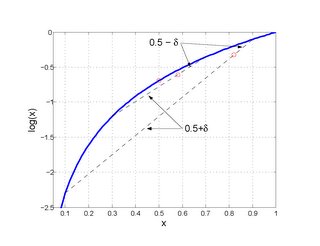
Note that the linear distributive probability relation demonstrated here is unique to the logarithm among other functions with the property previously mentioned.
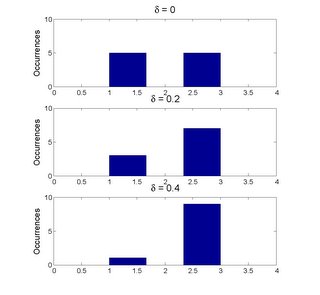
For continuous processes, the relation between joint and marginal partitions will tend to be symmetric in the joint space. In general, the mutual information between two random variables can be visualized as the degree to which the probability masses of the partitions in of one marginal space can be traced through the joint space to the marginal distribution of the other variable. The more certain this can be done, the stronger and more accurate will be the mapping between the divisions of the variables. This is then the basis for a global mapping between the variables that is statistically robust and measurably accurate.
If we are without any knowledge of the random variables that might be used to form the estimate of their pdf, the frequentist method of estimation is all that is available. The relative number of occurrences of an observation of the variables is the estimate of the probability of that event over those measurement values. The grouping of occurrences can be done several ways typically either by kernels or by histograms. Again, without a priori knowledge of the r.v.s, we favor uniform histograms for their computationally efficiency. The drawback of histograms is that they enforce a discrete partition on the observations regardless of whether the underlying process that generated the r.v.s is discrete or not. However, when the dimensionality of the data is even moderately great and the number of observations is fixed, any benefit in the use of smooth kernels in approximating the pdf of a continuous process is negligible. Since we envision a locally smooth method of reconstruction of the process relationship based on the local estimates of MI, the discreteness of histograms is not a primary concern.
The partitioning of the variable space by bins gives us a basis for making local relations between the variables (assuming a causal relation we will label these as 'input' and 'output'). Ideally, a local bijection exists between each input and output bin. A necessary and sufficient condition for this existence is that the joint probability of the input/output bin in the input/output space is equal to its marginal probability in both the input and output spaces. Of course, a bijection may not exist between the events that fall into the bin, only the bins themselves.
Entropy is the (negative of the) expectation of the logarithm of the pdf of a r.v. Unlike linear measures of concentration, the logarithm used in the entropy functional has the effect of disproportionately weighting the differences in a distribution between bins so that the closer to equivalency the distribution of probability mass between bins, the lesser the change in entropy. Conversely, small deviations from concentrations of probability mass lead to disproportionately greater differences in entropy.
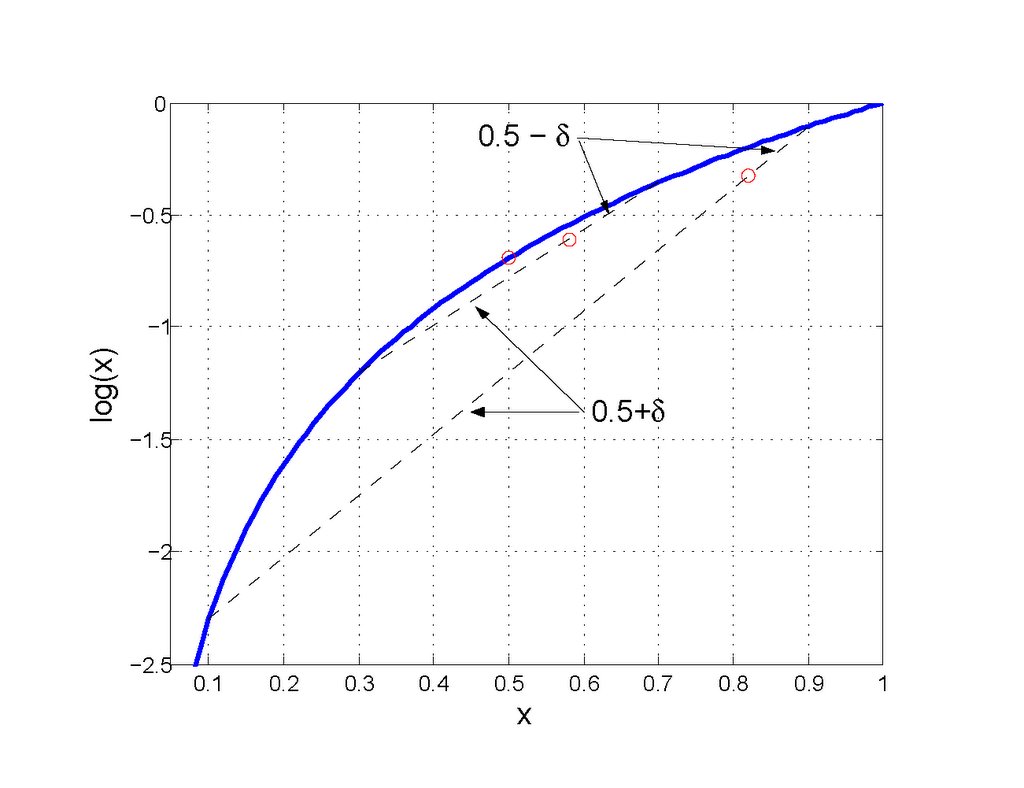
Note that the linear distributive probability relation demonstrated here is unique to the logarithm among other functions with the property previously mentioned.
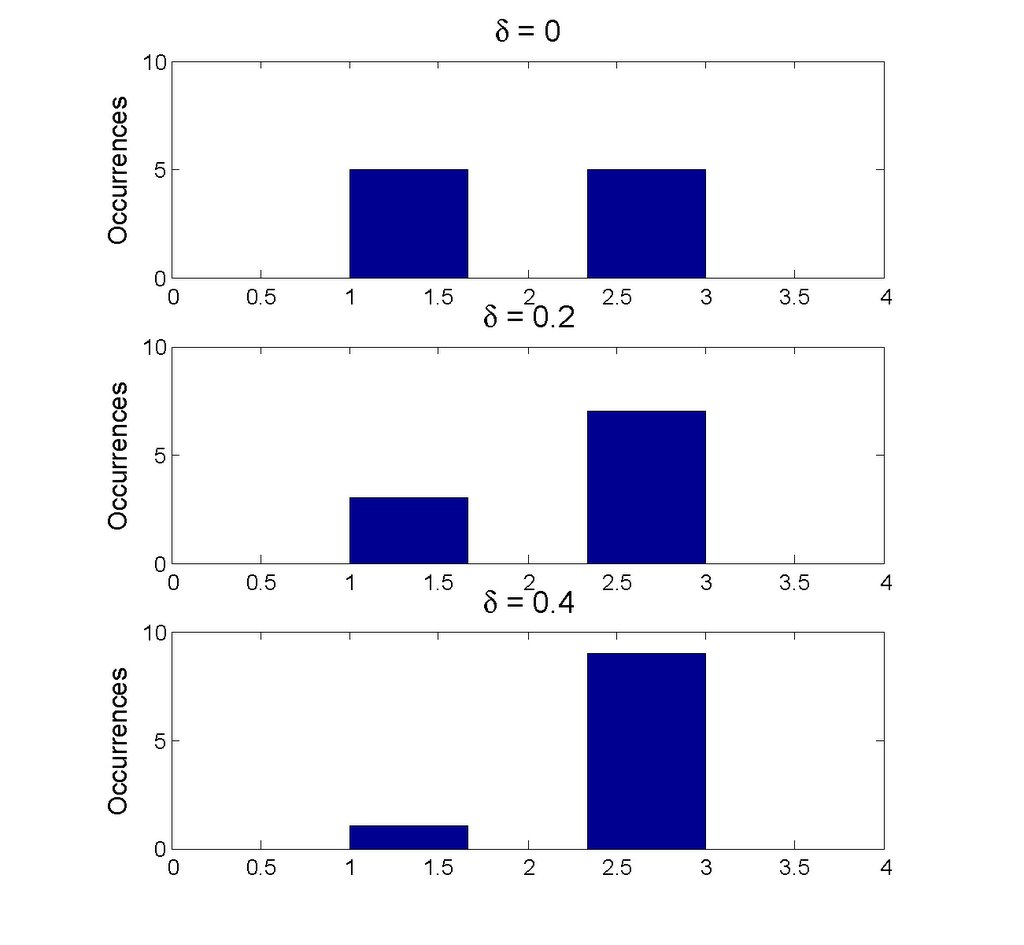
For continuous processes, the relation between joint and marginal partitions will tend to be symmetric in the joint space. In general, the mutual information between two random variables can be visualized as the degree to which the probability masses of the partitions in of one marginal space can be traced through the joint space to the marginal distribution of the other variable. The more certain this can be done, the stronger and more accurate will be the mapping between the divisions of the variables. This is then the basis for a global mapping between the variables that is statistically robust and measurably accurate.
Tuesday, December 28, 2004
Connections and Consistency
One obvious question that arises from the TNL post is “Why should the progressive player seek an interior solution?” For that matter, “Why should the conservative player seek an exterior solution?” Neither of these questions was directly addressed in the post. However, the personality-political affiliation study does give a hint to the answer to these questions. Remember, it is a remarkable fact that there is a measurable personality difference between liberals and conservatives.
We found that the primary intrinsic information-processing distinction between self-described progressives/liberals and conservatives was that liberals “feel” while conservatives “think”. Both terms should be understood in the context of the study. They tell us how about the mode of decision-making of the individual based on information presented by the environment. The distinction is not a product of the moral status of the decision maker, but the mode of decision does have moral implications. Since the vast majority of individuals consider themselves to be “good” in a moral sense irregardless of political affiliation, the distinction must be a function of how we judge the imperatives of good action in relation to the environment.
The conservative makes decision based on discrete, measurable actions on his environment. Rationalism is a method of organizing the environment in a logically consistent method such that the environmental entropy is reduced. That entropy which cannot be reduced is treated in such a way that it does not enter the moral calculus. Thus, the misfortunes of Job were a test of fidelity while other randomness is ascribed to either the unavoidable byproduct of physical laws of creation or the consequences of other’s actions for which a collective moral consequence is assumed. There is moral order in the environment of the conservative because the conservative believes that he acts on the environment for a moral purpose. Internal feelings of happiness or guilt are a consequence of this measurable action. Feeling follows thinking.
The moral viewpoint of the progressive is not primarily a function of his perceived action on the environment. His judgement of good and bad action is more directly a result of his internal harmony, i.e. "feeling". The conflict which arises from discordant forces is to be minimized for the maximization of the good of the liberal -- conflict is inherently bad. Thus progressives do not seek to interact at odds with the environment; they seek consensus. This is by definition the search for an interior solution as the social/economic model is defined. The external environment is rationalized to come into agreement with internal needs and desires. Thinking follows feeling.
We found that the primary intrinsic information-processing distinction between self-described progressives/liberals and conservatives was that liberals “feel” while conservatives “think”. Both terms should be understood in the context of the study. They tell us how about the mode of decision-making of the individual based on information presented by the environment. The distinction is not a product of the moral status of the decision maker, but the mode of decision does have moral implications. Since the vast majority of individuals consider themselves to be “good” in a moral sense irregardless of political affiliation, the distinction must be a function of how we judge the imperatives of good action in relation to the environment.
The conservative makes decision based on discrete, measurable actions on his environment. Rationalism is a method of organizing the environment in a logically consistent method such that the environmental entropy is reduced. That entropy which cannot be reduced is treated in such a way that it does not enter the moral calculus. Thus, the misfortunes of Job were a test of fidelity while other randomness is ascribed to either the unavoidable byproduct of physical laws of creation or the consequences of other’s actions for which a collective moral consequence is assumed. There is moral order in the environment of the conservative because the conservative believes that he acts on the environment for a moral purpose. Internal feelings of happiness or guilt are a consequence of this measurable action. Feeling follows thinking.
The moral viewpoint of the progressive is not primarily a function of his perceived action on the environment. His judgement of good and bad action is more directly a result of his internal harmony, i.e. "feeling". The conflict which arises from discordant forces is to be minimized for the maximization of the good of the liberal -- conflict is inherently bad. Thus progressives do not seek to interact at odds with the environment; they seek consensus. This is by definition the search for an interior solution as the social/economic model is defined. The external environment is rationalized to come into agreement with internal needs and desires. Thinking follows feeling.
Saturday, December 18, 2004
Human Transactions
We transact with others on a continuum of trust and power. On one end of the spectrum, what we receive from the transaction cannot be differentiated from a gift. On the other end, it is a product of force and power applied to another. One relationship relies on human intuition to be profitable; the other is a product of brute calculation. As individuals in a generic situation we chose to transact on that basis that we expect to yield the more favorable result. That decision is a product of our personality and experience. When transacting with other humans with whom we have no prior experience, we proceed according to a characteristic bias. This same bias is also projected on anthropomorphized institutions such as government and corporations.
The continuum of interaction is directly correspondent to the feeling/thinking axis of decision making that differentiates liberals and conservatives. Conservatives tend to view government as best suited to taking a limited, contractual relationship with the governed. Meanwhile, liberals seek a paternalistic government that “feels their pain”. So, our approach to politics is again an extension of our personalities. We should be aware of the bias that we bring to our deliberations of problems that we wish to objectify; the best solution applies uniformly to the mass of society and not to ourselves alone.
The continuum of interaction is directly correspondent to the feeling/thinking axis of decision making that differentiates liberals and conservatives. Conservatives tend to view government as best suited to taking a limited, contractual relationship with the governed. Meanwhile, liberals seek a paternalistic government that “feels their pain”. So, our approach to politics is again an extension of our personalities. We should be aware of the bias that we bring to our deliberations of problems that we wish to objectify; the best solution applies uniformly to the mass of society and not to ourselves alone.
Saturday, November 13, 2004
Information-Theoretic Dependency Analysis
If there were only one criterion in one dimension with which to differentiate the conservatives and liberals out of the four Myers-Briggs factors, then the summary results would be sufficient to answer the question. However, people are not so single dimensional; we expect that the political affiliation decision to be a more complex function of personality.
Let’s first loosen the condition that the differentiation must be a single boundary in one dimension. Let’s allow that along this dimension there could be clusters of liberal and clusters of conservative respondents separated by multiple boundaries. So instead of a measure of central tendency such as the mean or correlation, we need a more general metric of dependency to determine which dimensions of personality tend to separate respondents according to their political affiliation. The measure of choice is the mutual information (MI) between the distributions of the respondents' political affiliation and the respondents' Myers-Briggs scores in each dimension. These totals are shown below where the number of bins is chosen to equally resolve all Myers-Briggs totals for our sample down to the individual question level:
The objective is to be able to assign each of the uniformly distributed bins to a certain political affiliation of the four different possibilities (weak/strong and conservative/liberal). To do this we want to use that information that has the closest one-to-one relationship with the distribution of the respondent’s political affiliation. This is the dimension with the highest MI value. The total information to be covered in the output dimension of political affiliation is 1.14 nats (natural units). So, while the decision making dimension is still the most potentialy descriptive of political affiliation, it is by no means comprehensive. It is possible that there is complementary information in another dimension that will yield a better discriminant.
Let's now expand the investigation into two dimensions while reducing the number of bins in each dimension to nine (gender is included with two bins) in order that the proportion of total bins to data records remain above three. The first 6 of the 15 combinations in rank order are:
For a more direct comparison with the single dimension results let's limit the grid to 4x4 for a total of 16 bins:
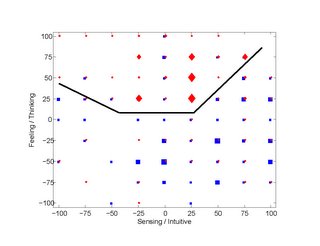
It is clear that a better differentiation in general can be had with certain combinations of two dimensions rather than just one. In this case the dimensions of processing and decision making should provide us with significant information by which to distinguish many conservatives from liberals. The plot below demonstrates this fact (red diamonds = conservatives; blue squares = liberals):
Compare the simplicity and efficiency of that discriminant to the dual case:
Let’s first loosen the condition that the differentiation must be a single boundary in one dimension. Let’s allow that along this dimension there could be clusters of liberal and clusters of conservative respondents separated by multiple boundaries. So instead of a measure of central tendency such as the mean or correlation, we need a more general metric of dependency to determine which dimensions of personality tend to separate respondents according to their political affiliation. The measure of choice is the mutual information (MI) between the distributions of the respondents' political affiliation and the respondents' Myers-Briggs scores in each dimension. These totals are shown below where the number of bins is chosen to equally resolve all Myers-Briggs totals for our sample down to the individual question level:
| Dimension | Bins | MI (nats) |
| Focus | 18 | 0.096 |
| Processing | 16 | 0.142 |
| Decision Making | 18 | 0.176 |
| Organizing | 19 | 0.143 |
| Age | 19 | 0.106 |
| Gender | 2 | 0.074 |
The objective is to be able to assign each of the uniformly distributed bins to a certain political affiliation of the four different possibilities (weak/strong and conservative/liberal). To do this we want to use that information that has the closest one-to-one relationship with the distribution of the respondent’s political affiliation. This is the dimension with the highest MI value. The total information to be covered in the output dimension of political affiliation is 1.14 nats (natural units). So, while the decision making dimension is still the most potentialy descriptive of political affiliation, it is by no means comprehensive. It is possible that there is complementary information in another dimension that will yield a better discriminant.
Let's now expand the investigation into two dimensions while reducing the number of bins in each dimension to nine (gender is included with two bins) in order that the proportion of total bins to data records remain above three. The first 6 of the 15 combinations in rank order are:
| Dimensions | MI (nats) |
| (Processing; Decision Making) | 0.391 |
| (Decision Making; Age) | 0.379 |
| (Focus; Decision Making) | 0.376 |
| (Decision Making; Organizing) | 0.363 |
| (Focus; Processing) | 0.363 |
| (Focus; Organizing) | 0.357 |
For a more direct comparison with the single dimension results let's limit the grid to 4x4 for a total of 16 bins:
| Dimensions | MI (nats) |
| (Processing; Decision Making) | 0.196 |
| (Processing; Gender) | 0.180 |
| (Decision Making; Organizing) | 0.173 |
| (Decision Making; Age) | 0.157 |
| (Decision Making; Gender) | 0.150 |
| (Focus; Decision Making) | 0.144 |
| (Organizing; Gender) | 0.136 |
| (Focus; Organizing) | 0.120 |
| (Focus; Processing) | 0.117 |
It is clear that a better differentiation in general can be had with certain combinations of two dimensions rather than just one. In this case the dimensions of processing and decision making should provide us with significant information by which to distinguish many conservatives from liberals. The plot below demonstrates this fact (red diamonds = conservatives; blue squares = liberals):

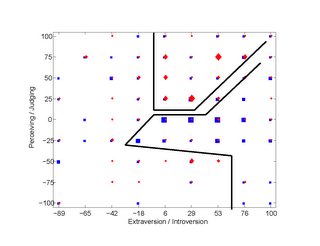
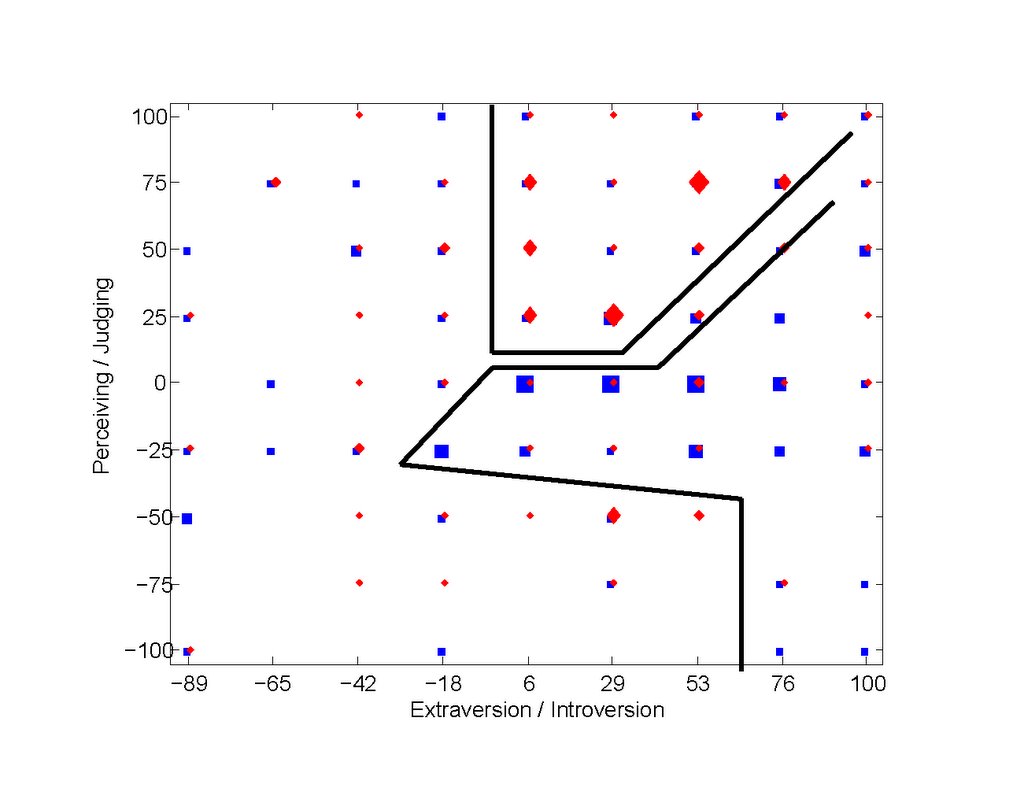
Compare the simplicity and efficiency of that discriminant to the dual case:
Subscribe to:
Posts (Atom)